


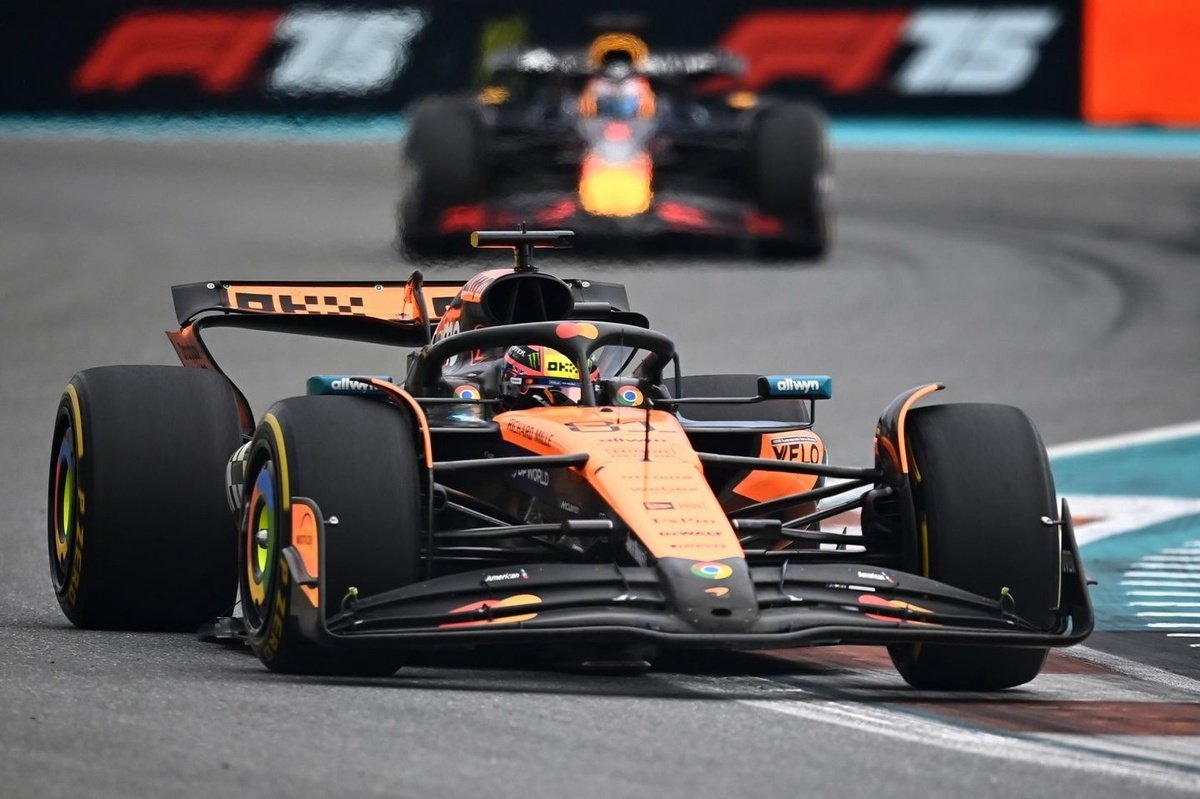
McLaren Dominates Miami Grand Prix: A Technical Review
The Miami Grand Prix showcased McLaren’s remarkable performance, setting a new benchmark in the 2025 Formula 1 season. Helmut Marko, Red Bull Racing’s advisor, encapsulated the disparity between teams by stating, “For the first time, we saw their pure speed,” as McLaren demonstrated a clear advantage over competitors with a final gap of nearly 40 seconds to third-place finisher George Russell.
Race Highlights
Lando Norris excelled in the Miami heat, recovering from a first-lap incident that relegated him to sixth place. Remarkably, he took just 13 laps to close the gap to Max Verstappen, benefitting from McLaren’s superior DRS setup and Verstappen’s battle with Oscar Piastri that further delayed Red Bull.
Norris’ performance underscored McLaren’s pace, which had often been obscured by race circumstances in prior rounds. This race marked a pivotal point, with both Norris and teammate Piastri effectively utilizing tire management strategies to maintain competitive lap times—one of McLaren’s noted strengths.
Technical Insights
McLaren’s success can be attributed to multiple factors, chief among them being tire management. Andrea Stella, McLaren’s team principal, highlighted, “Every time conditions become difficult for the tires…the car seems to do an excellent job of keeping them in an ideal operating window.” This engineering prowess is proving beneficial, particularly on hotter circuits.
The MCL39’s versatility has emerged as a game changer. Unlike the MCL38 from the previous season, the MCL39 is adept at adapting to varied track conditions, contributing to its pronounced effectiveness in slow corners—a crucial element on Miami’s challenging layout. The car’s mechanical and aerodynamic efficiency allows for smooth performance across both slow and high-speed sections, a balance where the Red Bull struggled.
Competitor Analysis
In contrast, Red Bull’s performance suffered partly due to overheating issues that hampered tire effectiveness. Christian Horner remarked on the sensitivity of tire temperatures, noting, “We had hotter tires than in Jeddah, and even a small temperature variation can change a lot of things.” While Verstappen showed resilience in the second half of the race, regaining speed in faster sections, it was insufficient to counteract McLaren’s dominant approach.
Conclusion
The Miami Grand Prix not only highlighted McLaren’s current supremacy but also marked a significant turnaround since last year. With innovations in tire management and overall vehicle design, the MCL39 stands as a testament to McLaren’s engineering excellence, demonstrating a full-strategic approach capable of contending at the highest levels of Formula 1 racing.
